
How a Bronx County Property Records Search Starts
There is no conventional county recorder counter to visit in the Bronx. New York City splits the work across several agencies. Begin with the Department of Finance Property Information Portal, called PIP, whenever a street address is in hand. Pick the suggested address. Save the borough, block, and lot number, the BBL. That number ties the tax account, parcel map, and recorded-document trail together. It does all of this without leaning on a name. A name may be indexed several ways.
A careful property search moves from identification to proof. Treat the PIP Property Owner field as a tax-record name. Then open ACRIS and read the newest deed for the same BBL. CityMap or the digital tax map shows the lot's position. Turn to DOB BIS and DOB NOW next. Use them for permits, violations, jobs, or a certificate of occupancy. No single step equals a title search or boundary survey.
- Find the Bronx address in PIP and record its BBL.
- Compare the Property Owner field with the latest ACRIS grantee.
- Review assessment, exemptions, sales, and recorded-document cards.
- Map the lot in CityMap and the PIP tax-map library.
- Request an official copy when a transaction or filing requires one.
Bronx County Property Records Offices and Portals
The Office of the City Register records Bronx deeds and mortgages. The Department of Finance keeps the assessment and billing side. The Bronx County Clerk handles Supreme Court files, judgments, and mechanic's liens. Tax liens and warrants also sit with that office. It is not the deed recorder. Keeping that split straight prevents most first-day confusion.
ACRIS Opens Bronx Deeds From 1966 Forward
ACRIS is the City Register's official index of recorded Bronx real estate documents. It covers 1966 to the present. Searches run by party name, parcel identifier, document type, CRFN or document ID, transaction number, and older reel-and-page references. A parcel search combines borough 2 with the block and lot. Enter lot 0000 to widen a search to the whole block. Co-op lookups may add a unit number.
The detail screen can list the CRFN. It also shows document and recording dates, document amount, parties and their roles, parcel identifiers, cross-references, and an image link. Deeds, mortgages, satisfactions, assignments, easements, liens, and corrections all appear here. Read the party role and document type first. Only then treat a name as owner of record.
The official ACRIS opening screen shows the routes into the document and parcel tools.
Its separate search paths explain why a BBL lookup and a party-name check both earn their keep.
PIP Connects a Bronx Address to the Tax Lot
PIP accepts searches by street address, BBL, borough and block, condominium number, co-op development, REUC, air lot, and subterranean lot. Results arrive as cards. The cards cover the property, building, land, assessment history, exemptions, sales, recorded documents, tax maps, and district facts. The Property Owner label helps. But it reflects the tax account. The tax roll can update on a different schedule than a newly recorded deed.
The Property Information Portal search screen makes every parcel category visible before a query begins.
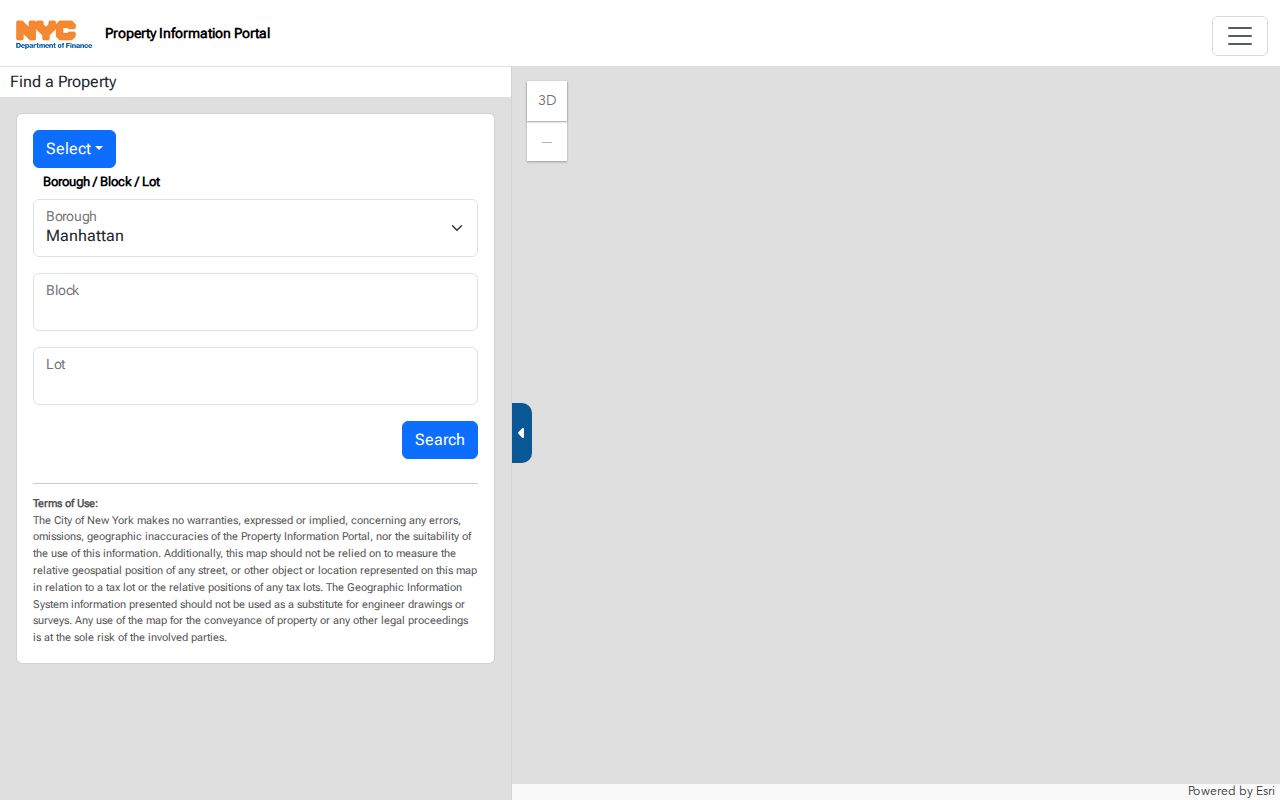
Parcel type matters. Condominiums, cooperative billing lots, and other interests rarely match a simple ground lot.
What Bronx County Property Records Document
Every record set answers a different question. Agreement among them beats any single isolated result.
| Record | What it shows | Official source |
|---|---|---|
| Deed and mortgage | Parties, recording dates, legal parcel references, and document images | City Register / ACRIS |
| Assessment | Market, assessed, taxable, and exemption figures | DOF / PIP and assessment rolls |
| Tax bill | Charges, credits, due amounts, and payment status | Department of Finance |
| Parcel map | Tax-lot geometry, BBL, map changes, and planning context | CityMap, PIP, ZoLa, MapPLUTO |
| Building record | Jobs, permits, complaints, violations, and occupancy documents | DOB BIS and DOB NOW |
| Court record | Foreclosure, partition, quiet-title, judgments, and related litigation | Bronx Supreme Court, eCourts, NYSCEF |
Bronx Assessment Values Are Not Sale Prices
New York City separates market value, assessed value, taxable assessed value, and taxable billable value. Class 1 property is generally assessed at 6 percent of market value. Classes 2, 3, and 4 use a 45 percent level. That level is subject to caps and transitional rules. Exemptions trim taxable value on their own terms. A recorded sale amount in ACRIS stands apart as a transaction fact. It may reflect circumstances an annual assessment model never captures.
PIP can display up to ten years of assessment history. The history includes fiscal year, building and tax classes, land and improvement components, totals, and change percentages. Tax bills are generally quarterly when assessed value is $250,000 or less. Above that figure they run semiannual. Current balances and due dates live on the tax bill itself, not the assessment card.
Bronx Parcel Maps Use Borough Code 2
Every Bronx BBL begins with borough code 2. The example 2-04901-0030 can also appear as the ten-digit 2049010030. CityMap places an address or BBL among streets, districts, ZIP areas, and nearby features. PIP supplies tax-map sheets and map history. ZoLa layers on zoning and planning context. MapPLUTO offers downloadable tax-lot land-use, building, zoning, geography, and landmark attributes.
Remember that the map polygon is an administrative tax lot, not a licensed survey. Lot-face symbols need care. Possession hooks need care too. Irregular waterfront geometry, common elements, air rights, and subterranean interests all need care. Historical alteration books and map effective dates explain a change. That is why an old deed may cite a lot number that no longer appears.
The official CityMap GIS view demonstrates the map and search layers used for Bronx research.
Carry the identified BBL back into PIP and ACRIS. The drawn outline is not legal boundary proof.
Permits Require Both BIS and DOB NOW
The Department of Buildings uses two overlapping systems. BIS is the older one. It searches by borough and address, block and lot, BIN, complaint, 311 reference, or violation number, and its building profile leads to jobs, violations, complaints, and certificates of occupancy. DOB NOW is the newer portal. It offers separate public search tiles for address, BBL, BIN, job number, device, licensee, and violation. A complete building-history review may need both.
Permits have limits. A permit history does not establish ownership, nor does an owner name prove lawful occupancy or approved work. Match the address, BIN, and BBL across both systems, note each result's date and status, and obtain the actual certificate or filing when the distinction matters.
Historic Bronx Ownership Crosses Old Jurisdictions
Online ACRIS coverage starts in 1966. Deeds recorded earlier sit in the Land Records Research Library, among older indexes, maps, deed books, and reel references. Jurisdiction also shifted. The western Bronx was annexed from Westchester County in 1874, eastern areas followed in 1895, and consolidation came in 1898. Bronx County itself was created in 1914. A nineteenth-century chain of title may therefore lead to records indexed under Westchester or New York County.
Neighborhood sources offer clues without replacing deeds. Fieldston's 140-acre planned layout holds 257 structures. Pelham Gardens sits near Laconia and Baychester, whose zoning study covered 163 blocks, and Co-op City's large-scale development dates to 1968. Such plans help identify the right tract. Municipal directories, tax photographs, the partial 1890 Police Census, and landmark records can add occupancy or building context.
Copies, Alerts, and FOIL for Bronx Records
ACRIS printing from a personal computer is free. Certified City Register copies cost $4 per page, and uncertified counter prints run $1, according to figures the City cites. Older records can still require an in-person library search. The free Notice of Recorded Document service accepts an address or BBL plus an email or text contact. It flags a later recording. But an alert alone proves neither validity nor fraud. FOIL covers New York agency records. It is not a substitute for a portal that already publishes the desired record. Agencies acknowledge or respond within the statutory process. Ordinary paper-copy charges are capped at 25 cents per page for pages up to nine by fourteen inches. Court records, certified copies, and archive work may follow different rules and fees.
Limits on Bronx County Property Records
Public records do a lot. They can identify a tax-record owner, show recorded transfers, trace assessment figures, and locate a tax lot. But they cannot promise marketable title. Nor can they settle a boundary, prove who occupies a home, provide a current appraisal, or avoid the genuine discrepancies that indexing errors, name variants, redactions, unrecorded interests, recent filings, and update cycles create.
Use records lawfully. Verify material conclusions with the record custodian, a qualified title professional, or a licensed surveyor, and never use owner information to harass or harm a person.
New York runs an Address Confidentiality Program. It offers a substitute mailing address plus forwarding. The program serves qualifying participants, and its protections remind us that a public tax lot and a private person's location are not the same question.
Keeping a Reproducible Bronx Property File
A practical Bronx file preserves more than a final name or number. Keep the address exactly as selected. Keep the ten-digit BBL too. Add the portal access date and the roll or fiscal year. Add the deed CRFN and any map effective date. When two records disagree, those details reveal the cause. Is it a new conveyance, a changed lot, a tax-roll lag, a party-name variant, or a different property interest?
Court and archive sources need a stated reason. A foreclosure, partition, quiet-title action, mechanic's lien, judgment, or probate matter may be involved. Any of these may explain an unusual transfer. But a docket entry is not a deed. A historic census, directory, tax photograph, or landmark file can support house history. None of them proves title. Labeling each source by function keeps the result accurate. It also makes any later update of the parcel file much easier.
Bronx research is strongest when the BBL stays the common thread. Addresses change. Entities rename, neighborhood labels shift, and a building may receive a new BIN after work. The parcel identifier lets you test those changes. It works across the Department of Finance, City Register, DOB, maps, and courts. And it separates administrative evidence from legal proof.
Context is everything in a records file. A market value without a fiscal year, a deed amount without a document type, or a lot outline without a map date can mislead, even when the number itself was copied correctly. So label every number. A short source note prevents that. Check that any link saved to the file points to the named official agency, since names and portals shift over time.
The same discipline applies to empty results. Record the attempted key, filters, parcel type, and date before concluding that no matching record exists. Portals change. A dated note about the search makes the next update much faster and guards against a changed interface.