
Choose a Bronx County Address, Owner Name, or BBL
Start with the strongest key you have. An address in PIP handles most ordinary lookups. A BBL nails down an exact tax lot. When the only clue is a person, a trust, or a business name, the ACRIS party index is the tool that fits. PIP offers no standalone owner-name search, though its address or parcel result displays the tax-record Property Owner. ACRIS instead searches the names attached to any recorded document.
| Starting key | First official tool | Result to save |
|---|---|---|
| Street address | PIP autocomplete | Bronx BBL and owner field |
| Owner or LLC | ACRIS party search | Role, CRFN, parcel, date |
| BBL | PIP and ACRIS parcel searches | Matching tax and deed records |
Walk Through the Bronx County Property Search
Type the street number and name into PIP. Pick the suggested New York City address. Confirm the borough reads Bronx. Copy the borough-2 BBL before reading anything else, and check that Property Type and Tax Class match what stands on the ground. Then work through the cards: Building and Land for dimensions and basic facts, Assessment for annual values, Exemptions for reductions, Sales for transfers, and Documents for recorded instruments.
- Resolve the address in PIP.
- Save the BBL and Property Owner entry.
- Search that BBL in ACRIS.
- Sort the deed results by the newest relevant recording.
- Check CityMap and DOB systems when location or work history matters.
The PIP search screen shows all supported parcel types.
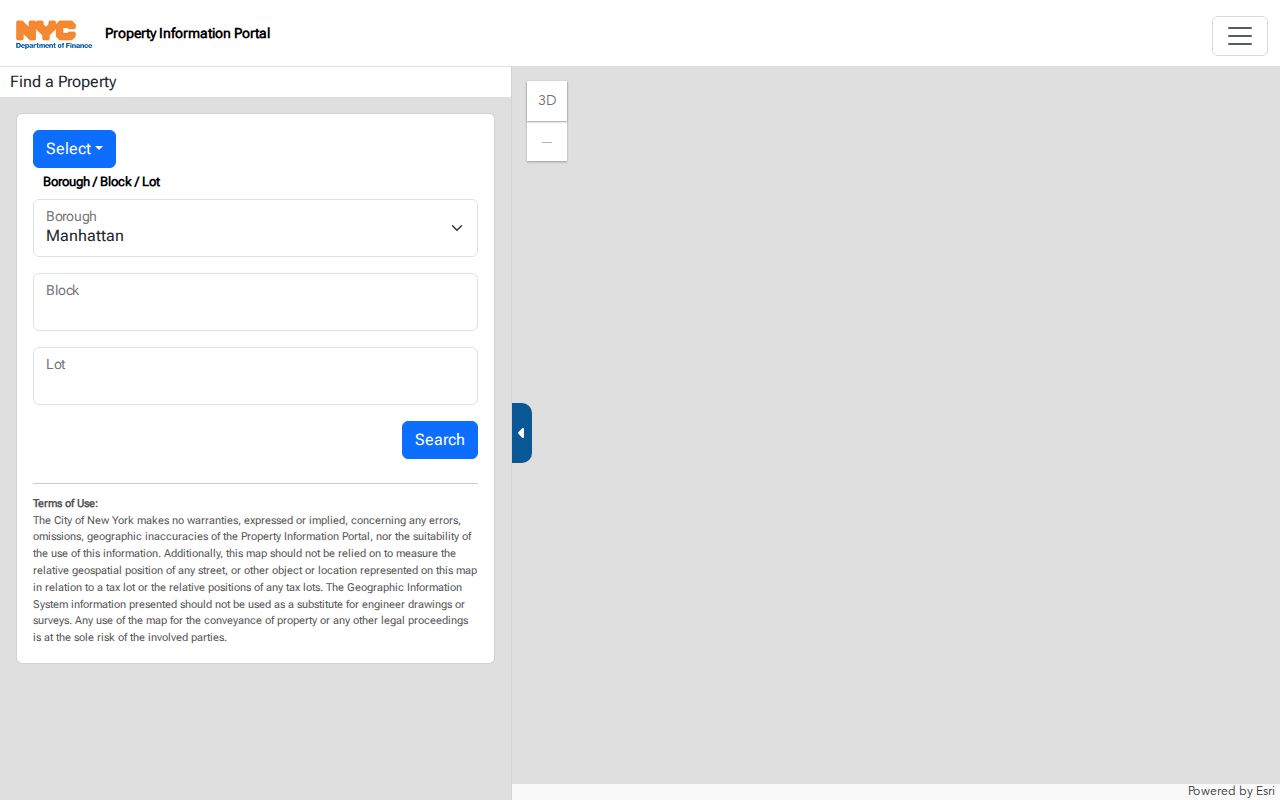
Condo, co-op, air-lot, and subterranean-lot settings keep a specialized interest from being read as a standard ground lot.
Read the Bronx Property Owner Field With Care
The Property Owner label belongs to the Department of Finance tax account. It is a snapshot, not a title opinion. No fixed rule times the deed-to-roll update. After a recent sale, weigh the field against the newest ACRIS deed's grantee, document date, recording date and time, CRFN, and BBL. Note the date you checked each system.
A mailing address may differ from the situs address. A trust, an estate, a nominee, or an LLC can stand in for an individual's name. A mortgage party is not always an owner. That is why document role and type matter more than a name appearing anywhere in a result.
Run an Exact Bronx BBL Through ACRIS
ACRIS asks for borough, block, and lot separately. Bronx is borough 2. Lot 0000 can return block-wide records, and co-op research can use the optional unit field. Date-range and document-class filters cut the noise, and after any tax-lot merger or split you should search former lots, document references, and tax-map history. The official parcel-search help shows these exact fields.
The parcel screen works most reliably once the BBL has been copied straight from PIP or CityMap.
Search a Bronx Owner or LLC in the Party Index
ACRIS gives individuals separate fields for last name, first name, middle initial, and suffix. Organizations go in the business field. Filters cover date, party type, borough, and class. Try sensible name variants, note whether each party is grantor, grantee, lender, borrower, assignor, or another role, then confirm the linked parcel. The ACRIS party-name guide shows both routes.
Entity names can also be cross-checked in the New York Department of State business database. A filing address there proves nothing about ownership.
Interpret Bronx Sales and Document Rows
PIP gives a quick list of recent sales and recorded documents. ACRIS carries the fuller detail. Pull the document type, amount, parties and roles, document date, recording date and time, CRFN, BBL, and any references or corrections. A stated amount may not equal open-market value. A mortgage amount is not a sale price. The ACRIS detail guide identifies the fields returned for a chosen document.
Use the recorded image and any referenced instruments to trace corrections, releases, and the transaction's place in the chain.
Use BIN, BIS, and DOB NOW After the Parcel Match
A BIN identifies a building. A BBL identifies a tax lot. BIS searches run by address, block and lot, BIN, complaint, 311 reference, and violation number. DOB NOW separately offers address, BBL, BIN, job-number, device, licensee, and violation searches. Coverage differs, so check both. Building jobs, violations, complaints, and certificates of occupancy add regulatory history, not title proof.
Resolve Historic and Ambiguous Bronx Addresses
If autocomplete finds nothing useful, reach for other keys. Try the BBL, former street names, old lot numbers, the legal description, and block-wide ACRIS lot 0000. History matters here too. Western areas joined New York County from Westchester in 1874, eastern areas followed in 1895, consolidation came in 1898, and Bronx County began in 1914. Pre-1966 instruments require the Land Records Research Library and may point to earlier county indexes.
A PIP sample can legitimately return an unpopulated card. That blank is a cue, not a verdict. Move on to ACRIS, CityMap, counter records, historic tax maps, and the library before concluding the parcel has no history.
What a Bronx County Property Search Cannot Prove
A tax owner, one deed, a GIS outline, a directory entry, or a business filing cannot alone establish complete ownership. Many things can bend a result. Unrecorded interests, name collisions, fiduciary transfers, redactions, map changes, and recent filings all qualify. A Bronx County property search ends best on paper. List the BBL and access date first. Add the PIP owner, the latest deed and grantee, any discrepancies, and the documents still needed.
Search limit. Official indexes support research and due diligence, but they do not replace a title examination, certified record, appraisal, or licensed boundary survey.
A Bronx County property search result can shift for innocent reasons. A spelling choice, a filtered query, or a different parcel number can make the same property look changed. Whenever a conclusion will be shared, preserve the exact query terms and source dates along with the result, so a later reader can tell the difference.
Documenting a Bronx County Property Search
Some deeds need a second look. A life-estate deed splits present from future interests. An executor signs for an estate. A trustee acts for a trust whose name may differ between the tax roll and deed records. An LLC can rename or merge. Run each party through the proper ACRIS field. Keep the role, document class, and parcel number tied to whatever comes back.
Older addresses take extra care. Compare the current tax map with alteration history. Do this before treating a historic street and a modern BBL as the same land. A former lot can hide an acquisition deed under the old identifier. The annexation timeline then decides where the next record sits. It may be in older Westchester or New York County material.
Building and land cards carry administrative facts. Dimensions, class, and neighborhood fields can confirm the parcel but say nothing about condition or lawful work. BIS and DOB NOW handle the regulatory follow-up. Each covers different ground. A hit in one does not excuse skipping the other when permits, violations, jobs, or occupancy documents matter.
A good note can stay brief. List the starting key, resolved address, BBL, parcel type, PIP owner of record and date, latest deed with its recording date, the map check, and any unresolved conflict. That habit keeps a copied search result from being mistaken for a conclusion the property records never supported.
Filters should narrow evidence, not bury it. Start broad enough to catch spelling or classification variations, then note why anything was excluded. In ACRIS, weigh individual against business searches, party type, borough, date range, and document class. In PIP, confirm the address and parcel mode. In DOB tools, try the stable BBL or BIN when a street form fails. This measured approach beats repeating the same text query.
When ordering a copy, use the exact document identifier. Ask whether certification is truly needed. A computer image may settle an ordinary research question. A legal filing, however, may require a certified City Register copy. If data is not online, find the proper custodian before turning to FOIL. A focused request naming the record, parcel, date span, and preferred electronic format works far better. It beats a demand for everything about an address.
Last, tell a true zero-result search apart from a technical or indexing failure. Retry the exact BBL. Drop an overly narrow date filter. Test the block-wide lot option, and check former lots. If the portal still comes up empty, find the counter, library, archive, or agency request that keeps the inquiry alive. Say the online search found no match rather than claiming no record exists. That wording respects the limits of the interface. It also keeps the offline path open for any Bronx County property records search.