
Bronx County Deed Records Begin in ACRIS
In the Bronx, deeds and mortgages go to the Office of the City Register. They do not go to the Bronx County Clerk. ACRIS is the public index. It reaches back to 1966. You can search it several ways. Options include party name, BBL, document type, CRFN, document ID, transaction number, and older reel and page identifiers. The County Clerk keeps a different set of duties. That office holds Supreme Court records, judgments, liens, naturalizations, business certificates, and archives. So Bronx property records and court filings live in two separate places.
| Instrument | Question it helps answer | Detail to verify |
|---|---|---|
| Deed | Who conveyed an interest to whom? | Grantor, grantee, BBL, dates |
| Mortgage | What financing was recorded? | Borrower, lender, amount |
| Satisfaction | Was a mortgage released of record? | Referenced instrument |
| Assignment | Was an interest transferred? | Roles and linked CRFN |
| Easement or correction | What right or error was addressed? | Legal description and references |
Search Bronx Deeds by Grantor or Grantee
ACRIS splits party search into separate fields for last name, first name, middle initial, and suffix. It also has its own field for business names. Filters for date, party type, borough, and document class help narrow the Bronx deed records index. Try name variants. Read the role column carefully. A lender, borrower, assignor, executor, or mere signatory is not automatically the fee owner. The official party search instructions show the fields used for Bronx deed records.
Match each plausible name result to its BBL and legal description before adding it to the chain of title.
Search Bronx County Deed Records by BBL
Searching by parcel usually beats a name-only search. Enter borough 2, then the block and lot. Lot 0000 can surface records indexed to the whole block, and a co-op search may pull in the unit as well. After a merger, split, or alteration, check the map history and any prior lot numbers. The ACRIS parcel guide illustrates the exact BBL form.
Bring the BBL over from PIP or CityMap intact. Keeping leading zeroes and the parcel identifier consistent ensures the deed search lands on the right Bronx County parcel.
Read a Bronx ACRIS Detail Page
A Bronx ACRIS detail page packs a lot into one view. Expect the CRFN, a document ID, recording and document dates, and the transfer amount. Party names and their roles appear alongside parcel data and cross-references. An image link usually sits nearby. The official field list spells out what the detail view returns. Read everything together rather than one field at a time. A correction deed can rewrite a name or a legal description. A satisfaction points back to the mortgage it retires. A deed amount may reflect a partial interest or a non-market transfer. It is not always a true sale price.
Before trusting the indexed details, open the document image and confirm it matches. The parties, parcel, and reference data on the deed record should all agree with what the image shows.
Trace a Bronx Chain of Title Backward
Begin with the newest deed recorded against the current BBL. Note the grantee. Then pivot to the grantor as the next likely owner of record to chase. Locate that grantor's own earlier acquisition. Compare legal descriptions and any prior lot numbers before repeating the step. Expect interruptions to a clean sale-to-sale chain. Corrections, referee deeds, executor deeds, and other referenced instruments belong in the sequence too.
- Confirm the current BBL.
- Open the latest relevant deed.
- Write down both parties, dates, CRFN, and legal parcel.
- Search the grantor's acquisition.
- Mark gaps rather than guessing across them.
Reach Bronx Deeds Before 1966
ACRIS traces Bronx County property records online only back to 1966. Older deed research takes a different path. The Land Records Research Library holds the earlier material. It includes deed books, indexes, reels, tax maps, and alteration books. Boundary history matters too, because annexation shifts a property search across jurisdictions. Western Bronx land belonged to Westchester until 1874. Eastern land joined in 1895. Greater New York formed in 1898, and Bronx County itself was created in 1914. Each date tells a searcher which office may hold the parcel's earliest deed.
Coverage cutoff. Treat 1966 as the ACRIS online starting point and document the older book, reel, page, map, and jurisdiction used for each earlier link.
Order Bronx Deed Copies and Recording Alerts
ACRIS deed images can be viewed and printed without charge. Certified copies cost $4 per page. Uncertified prints from the City Register counter run $1 per page under posted city fee schedules. Ask the office to confirm the current charge before ordering. For ongoing monitoring, a free Notice of Recorded Document alert is available. It tracks an address or BBL by email or text. The recording-notice form shows the registration route.
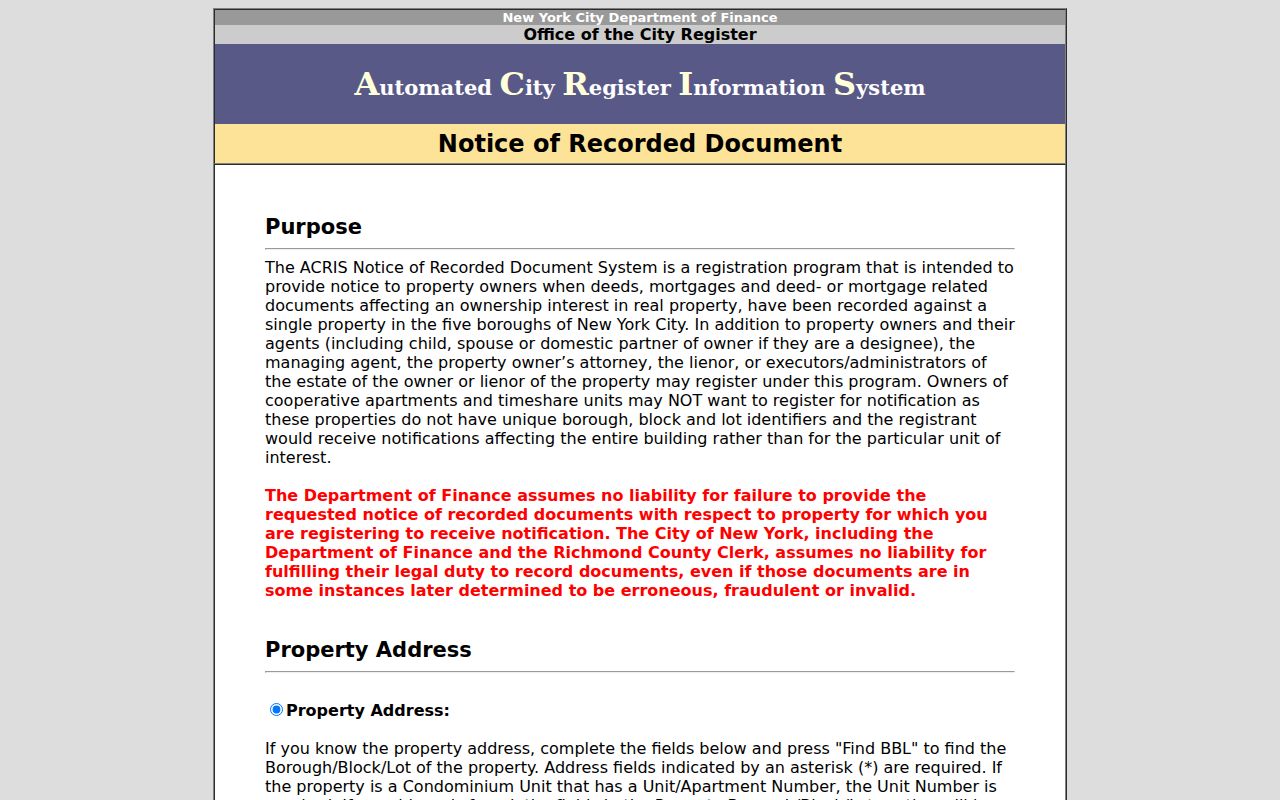
Alerts flag filings; they do not judge validity.
Know the Limits of Bronx County Deed Records
An ACRIS index search is not a title examination. Deed records have limits. They may not reveal unrecorded rights, restrictive agreements outside the retrieved chain, possession claims, survey questions, redacted information, or indexing errors. Careful work means matching names, roles, BBLs, legal descriptions, dates, and references. Get certified evidence whenever the intended use demands it. A grantor conveys an interest, and a grantee receives it. A quitclaim deed passes only whatever interest the grantor holds, without the assurances tied to other deed forms, while a chain of title is the full linked sequence rather than one isolated document.
Build a Defensible Bronx Deed File
Know the instrument before trusting the file. A mortgage secures a debt. An assignment moves that interest, and a satisfaction releases it. An easement grants a use right without transferring the parcel itself. Correction instruments fix earlier errors. Read the document image and its references before judging what a filing actually does.
Dates carry separate meanings. Execution shows in the document date. The recording date and time mark entry into the public record. A CRFN identifies a modern filing, so keep it alongside the BBL and the party roles; that way another researcher can pull the same evidence later.
Pre-1966 ownership needs a backward walk. Start at the last confirmed ACRIS deed and trace its legal description and grantor. Map alterations sometimes expose an earlier lot, and older books and indexes then carry the chain further back. Transfers spanning the 1874 or 1895 annexations may lead into Westchester records, and events predating the county's 1914 creation may sit under New York County indexing.
Match the copy to the purpose. A screen image suits ordinary research. A counter print reproduces the record without certification. A certified copy carries official authentication, which some receiving bodies require, so confirm that rule before paying. Certification still cannot turn a broken chain into a title opinion.
Set up fraud monitoring only after the baseline search. An owner can register an address or BBL for notices about later recorded documents, usually by email or text. The alert stops nothing. It does not block recording, authenticate a signature, or settle legal effect. Open the new CRFN. Compare parcel and parties against what you know. Contact the City Register or a professional when something looks unfamiliar.
A complete deed abstract lists the essentials. Include the property identifier, instrument type, grantor, grantee, document date, recording date, CRFN or book and page, and consideration if relevant. Add every cross-reference used. Keep confirmed conveyances separate from mortgages and supporting court events. That compact structure makes the chain auditable. It leaves out sensitive details that identify neither the parcel nor the transfer.
A mismatch between deed description and tax parcel calls for a pause. Compare the referenced map, former lot, and related instruments before continuing. A recorded description can predate the current BBL. A modern tax identifier should never be attached to an older transfer without evidence linking the two.